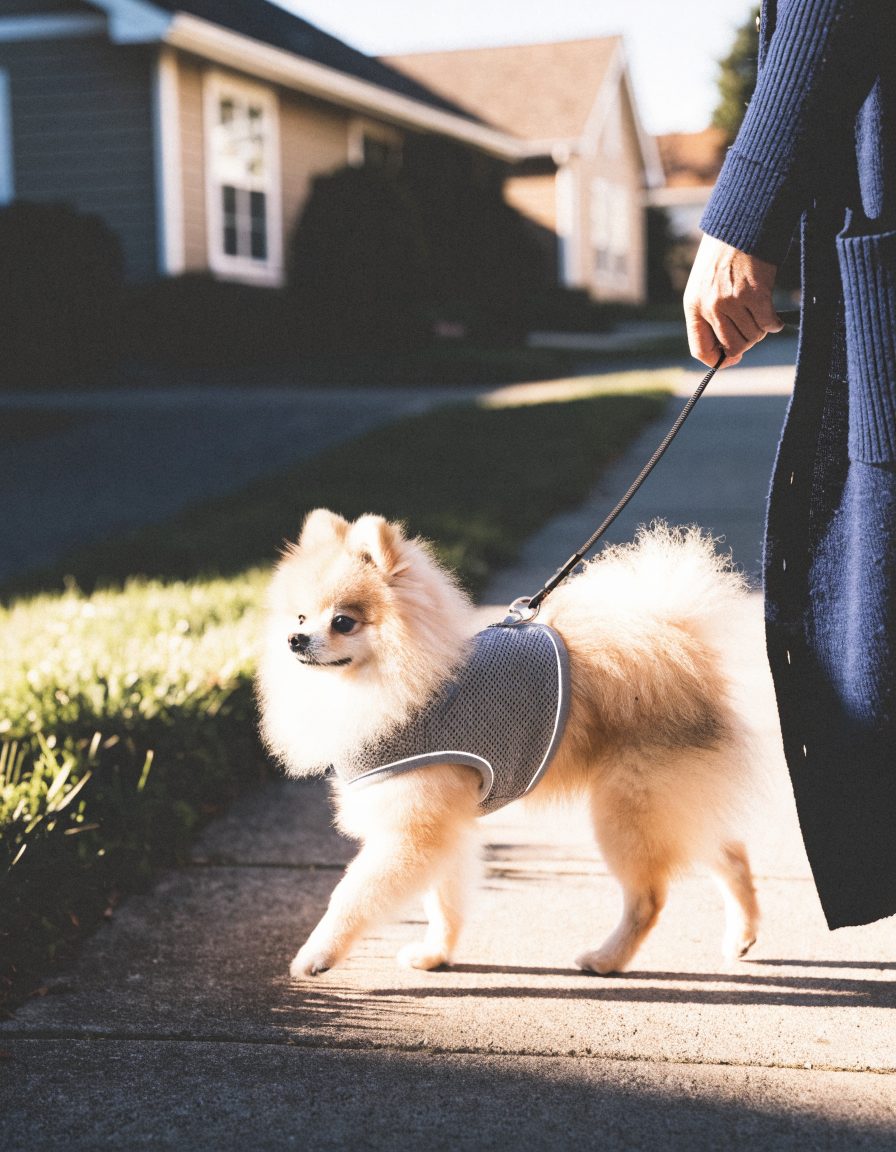
What is happening in the neck
A collar sits across the front of the neck. Directly underneath it, close to the skin, is the trachea: the windpipe. When the dog lunges and the leash goes tight, the collar presses into the windpipe. Researchers who placed a pressure sensor on the throat side of the collar recorded that pressure on ordinary walks, and it changed with the collar's material. Press on a windpipe and the body's response is to cough.
On a large dog with a thick neck, that pressure is spread over more tissue. On a 7 lb Chihuahua, the collar sits over most of the neck there is.
When the cough is a sign of something more
For many dogs, a cough on a hard pull is just a cough on a hard pull. It is worth a vet visit when:
- It is a loud, dry honk, like a goose, rather than a single throat-clear
- It happens on most walks, not once in a while
- It also happens when you pick the dog up, when it gets excited, or after it drinks
- The dog is a toy breed: Yorkie, Pomeranian, Chihuahua, toy poodle, Shih Tzu, Maltese
- The dog tires quickly, wheezes, or breathes hard after the fit
The American College of Veterinary Surgeons lists coughing when the collar is pulled and coughing when picked up among the signs of tracheal collapse. A sudden harsh cough after time with other dogs can also be kennel cough, which the American Kennel Club describes as highly contagious.
Four things to change on your next walk
1. Clip the leash to a harness, not the collar
This is the one change vets agree on for dogs with tracheal collapse. Choose a harness where nothing crosses the front of the neck, and check it with a pull test: clip the leash, pull gently forward, and watch whether any strap moves up toward the throat. More in what to look for in a harness.
2. Take the excitement out of the start
Many dogs pull hardest in the first two minutes, when excitement is highest, and excitement is itself a cough trigger. Clip the harness on and wait by the door until the dog settles before you open it.
3. Stop when the leash goes tight
The simplest loose-leash method: when the leash goes tight, stand still. When it goes slack, walk on. Most dogs learn that pulling stops the walk. It takes patience, and it works on a harness too.
4. Pick the cooler hour
VCA lists hot and humid weather among the triggers for a collapsing-trachea cough. In summer, walk early or late.
When to stop the walk
If a coughing fit does not settle within a few minutes, carry the dog home, holding it under the chest and the rear rather than by the front legs. Blue or gray gums, fainting, or struggling to breathe are an emergency: call your vet or an emergency clinic.