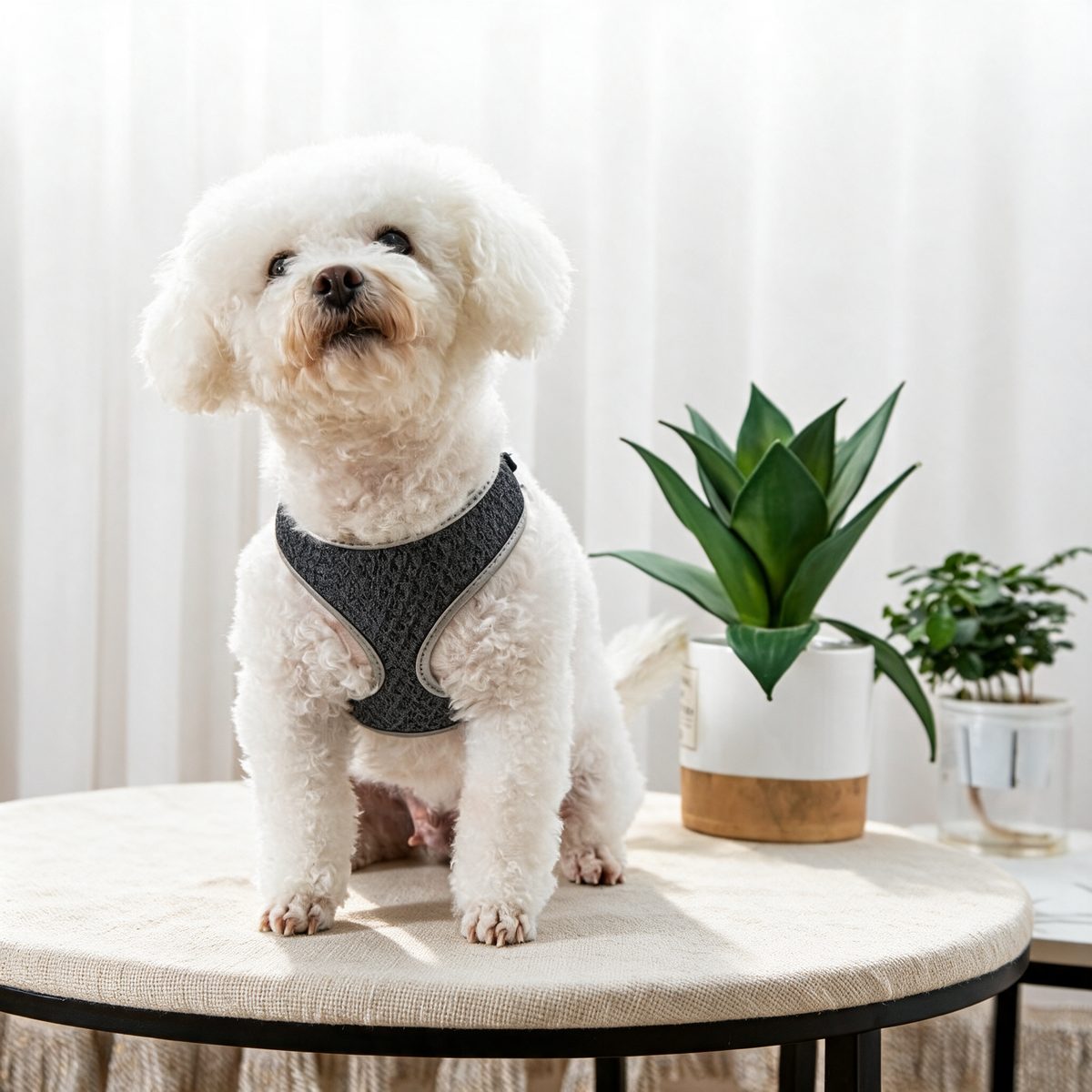
VCA and the American College of Veterinary Surgeons both tell owners of dogs with tracheal collapse the same thing: use a harness, not a collar. They do not say which harness, and the shelves are full of harnesses that still put a strap across the neck. These are the checks that matter.
A note before we start: we make one of these harnesses. We have written this so you can judge any harness, ours included.
Seven things to check
1. Nothing crosses the front of the neck
Look at the harness laid flat and find every strap that will touch the dog. If one forms a loop that goes over the head and sits around the neck, that loop is where the pull will land when the dog lunges. The goal is that the front of the throat has nothing on it at all.
2. The pull lands on the chest
The part that takes the load should be a wide, padded panel across the breastbone, the broad flat bone between the front legs. Narrow straps concentrate force; a wide plate spreads it.
3. Step-in, not over the head
A step-in harness goes on with the front paws stepping into two leg holes, then closes over the back. Nothing passes over the ears or around the face, which also matters for dogs who duck away from anything near the head.
4. The leash ring sits on the back
A ring between the shoulder blades means the leash pulls from above and behind, away from the throat. Front rings are made to turn a strong dog sideways. The researchers behind a 2006 collar and harness study noted that many harnesses still press at the thoracic inlet, the spot where the neck meets the chest, so on a toy dog a front ring can bring pressure back toward the neck.
5. Sizes made for very small dogs
Many harness ranges start at "small", which can mean a 15 lb dog. A Yorkie or Chihuahua in a harness that is too big will slip it or have straps sitting in the wrong place. Look for a smallest size that starts below 5 lb if your dog is tiny.
6. Light, breathable material
Heat and humidity are on VCA's list of cough triggers. Mesh that breathes keeps the chest cooler on summer walks. Heavy padding on a small dog can add warmth without adding comfort.
7. A fit that stays put
The harness should be snug enough that it cannot shift up toward the neck, with about two fingers of room under the straps. The American Kennel Club suggests a little extra room for harnesses so the fit is not too tight when the dog pulls. Our measuring guide walks through it.
The main harness types compared
| Type | How it goes on | Front of the neck | For a dog with tracheal collapse |
|---|---|---|---|
| Step-in vest | Paws step in, closes on the back | Clear | Usually the best fit for the job |
| Step-in strap harness | Paws step in, clips on the back | Clear, but narrow straps | Works if straps sit on the chest, not under the armpits |
| Over-the-head vest | Neck loop over the head, belly strap | Loop near the neck | Check it does not ride up under pull |
| Y-front harness | Over the head, Y-shaped front strap | Y sits at the base of the neck | Fit carefully; check under pull |
| Front-clip no-pull harness | Over the head, ring on the chest | Strap across the lower neck | Built for strong pullers; often a poor match |
The 10-second pull test
- Put the harness on and clip the leash where you normally would.
- Hold the leash and pull gently forward and up, the way a lunge would.
- Watch the straps. If any strap moves up toward the throat or tightens around the neck, the leash is still reaching the windpipe.
Try it on the harness your dog already has. If it passes, you may not need a new one.
How the Collarless vest measures up
Since we sell one, here is ours against the same list. It is a step-in mesh vest that closes with a buckle over the back. The leash clips to a steel D-ring between the shoulder blades, and a padded chest plate sits across the breastbone. Nothing crosses the front of the neck. It comes in four sizes by weight, starting with XS for dogs up to 5.5 lb and going to L for dogs up to 33 lb, with reflective piping on the edges. It is walking equipment, not a medical product, and it does not change the condition itself. It changes where the leash pulls.