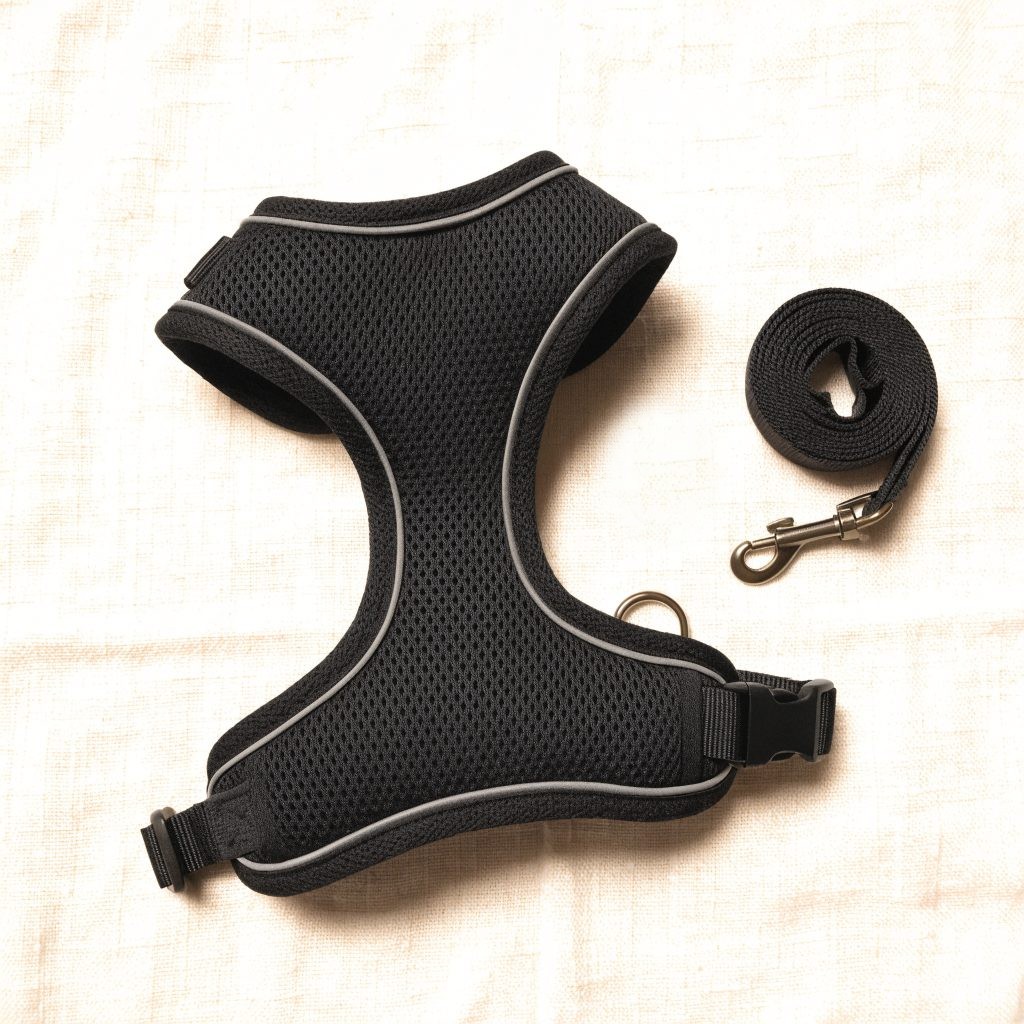
A harness only keeps the leash off the throat if it fits. Too big and the straps slide toward the neck, or the dog backs straight out. Too small and it will not close, or it rubs behind the legs. Here is how to get it right in about five minutes.
What you need
- A soft measuring tape, or a piece of string and a ruler
- A scale: bathroom scale, kitchen scale, or the one at your vet's office
- A favorite snack, to keep a small dog standing still
Step 1: measure the chest girth
- Stand the dog up. The American Kennel Club advises measuring with the dog standing naturally, weight on all four feet, not sitting or lying down.
- Find the widest part of the rib cage. It is usually just behind the front legs.
- Wrap the tape all the way around, snug but not tight.
- Leave two fingers of room between the tape and the dog. The AKC suggests a little extra room for harnesses so the fit does not become too tight when the dog pulls.
- On a fluffy dog, press the tape down through the coat. A Pomeranian or Shih Tzu measured over the fur can come out a size too big.
Step 2: measure the neck, if the harness asks for it
Over-the-head harnesses need a neck girth: around the base of the neck where a collar would sit. Step-in harnesses usually do not, because nothing goes around the neck.
Step 3: weigh the dog
For toy breeds, weight is often the most reliable number, and many small-dog harnesses size by it. To weigh a small dog at home, weigh yourself, then weigh yourself holding the dog, and subtract. For dogs under 5 lb, a kitchen scale is more exact.
Step 4: read the chart, then size up if in doubt
Every brand sizes differently, so use that brand's own chart, not a general one. Some harnesses are sized by the dog's measurements and some by the harness itself, as the AKC points out. If your dog sits between two sizes, choose the larger one. A roomy harness can be tightened on the straps. A tight one may not close at all.
For reference, here is the Collarless chart, which sizes by weight:
| Size | Weight | Typical breeds |
|---|---|---|
| XS | Up to 5.5 lb | Teacup Yorkie, tiny Chihuahua, small Maltese |
| S | 5.5 to 13 lb | Yorkie, Pomeranian, Chihuahua, Maltese, small Shih Tzu |
| M | 13 to 22 lb | Shih Tzu, Pug, small French bulldog, miniature poodle |
| L | 22 to 33 lb | French bulldog, Pug, Boston terrier |
Step 5: check the fit on the dog
- Two fingers slide under every strap, no more.
- Nothing sits on the front of the neck.
- Nothing rubs in the armpits when the dog walks.
- The pull test: clip the leash and pull gently forward. If anything shifts up toward the throat, adjust it or try a different style.
- The back-out test: walk backward carefully with light tension on the leash. A well-fitted harness stays on.
Check again after the first week. Straps can loosen as the material settles, and puppies grow quickly.