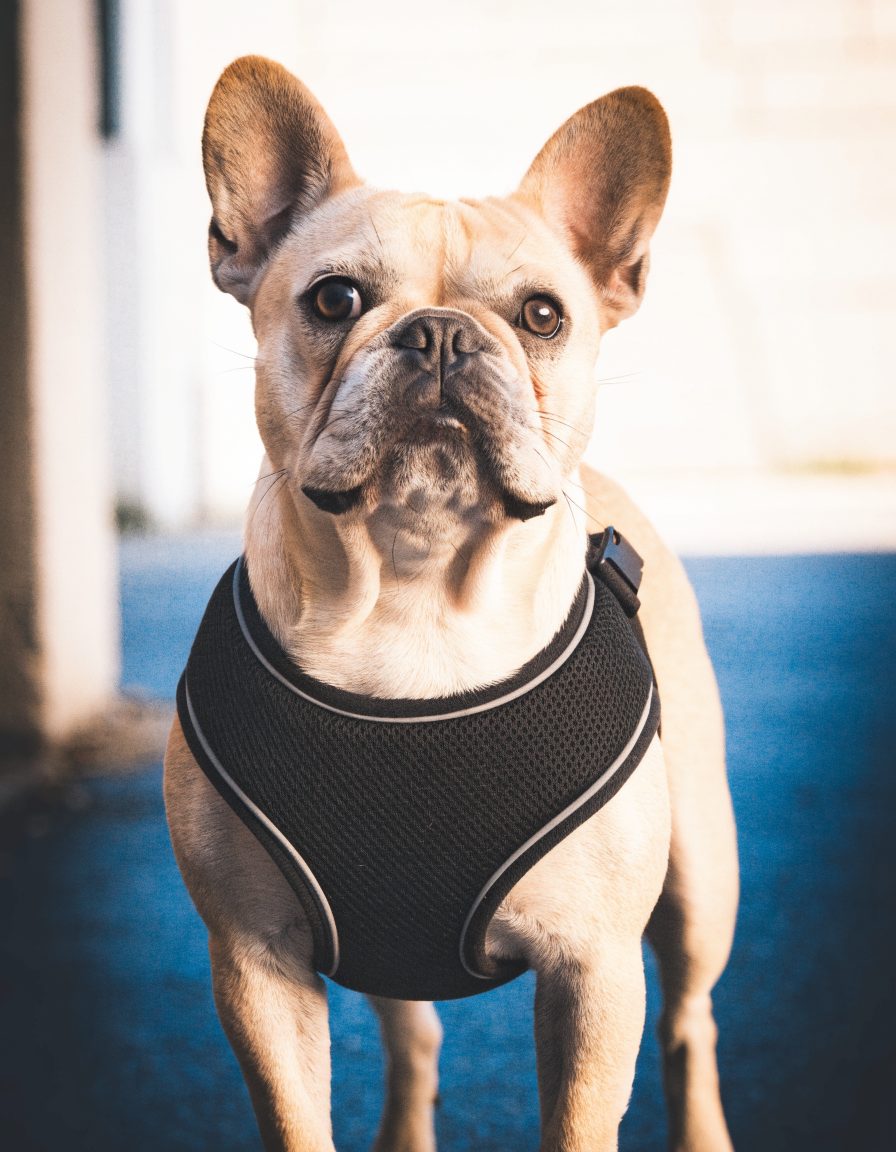
Why flat-faced breeds are different
French bulldogs, Pugs, Boston terriers, Shih Tzus and other short-faced breeds are called brachycephalic: the bones of the skull are shortened, which gives the pushed-in face. The soft tissue of the nose and throat does not shrink to match. VCA describes brachycephalic airway syndrome, often shortened to BOAS, as a group of upper airway abnormalities that can include:
- Stenotic nares: narrowed nostrils that restrict airflow
- An elongated soft palate that partly blocks the entrance to the windpipe
- Everted laryngeal saccules: small pouches in the voice box pulled into the airway
- A hypoplastic trachea: a windpipe narrower than normal
Signs include noisy breathing, snorting when excited, snoring, tiring easily and overheating. VCA notes most dogs are diagnosed between 1 and 4 years of age.
What vets say about collars and harnesses
Both sources are direct. VCA: dogs with BOAS should be fitted with a harness that does not tug at the neck area, and regular neck collars are not advisable because they can put undue pressure on the neck. Cornell's Riney Canine Health Center lists "use a harness instead of a neck collar" among its management steps, alongside a healthy weight, less panting, and avoiding heat and humidity.
There is an eye angle too. A 2006 study found that pulling against a collar raised pressure inside the eyes, while a harness did not produce a significant rise. The authors advised a harness for dogs with weak or thin corneas, glaucoma or other conditions where higher eye pressure could do harm. If your flat-faced dog has an eye condition, mention collars to your vet.
What to look for in a harness for a Frenchie or Pug
| Check | Why |
|---|---|
| Nothing across the front of the neck | The point is to keep pressure off an airway that is already narrow |
| A wide chest panel | Frenchies and Pugs are broad in the chest, which gives the load a big area to spread over |
| Leash ring on the back | Pull comes from above and behind, away from the throat |
| Breathable mesh | Heat and humidity make BOAS signs worse, according to VCA and Cornell |
| Step-in design | No loop squeezed over a wide head and short neck |
| Clear of the armpits | Short legs and a deep chest make rubbing behind the legs common |
Do the pull test before you rely on any harness: clip the leash, pull gently forward, and watch whether any strap rides up toward the throat.
Sizing a broad, short dog
Frenchies and Pugs often have a chest girth that is large for their length and weight. Measure around the widest part of the rib cage, just behind the front legs, with the dog standing. If your dog falls between sizes, size up and tighten the straps. Our step-by-step measuring guide covers it. In the Collarless range, M covers 13 to 22 lb and L covers 22 to 33 lb, which is where most adult Frenchies and Pugs land.
Walks in warm weather
VCA advises keeping dogs with BOAS out of heat and humidity, with air conditioning in summer, and controlling exercise and stress. In practice:
- Walk early in the morning or late in the evening in summer
- Keep walks short and unhurried, with shade breaks
- Carry water
- Stop if breathing turns loud and labored, and rest somewhere cool
Bluish gums or collapse are an emergency. Call your vet or an emergency clinic straight away.