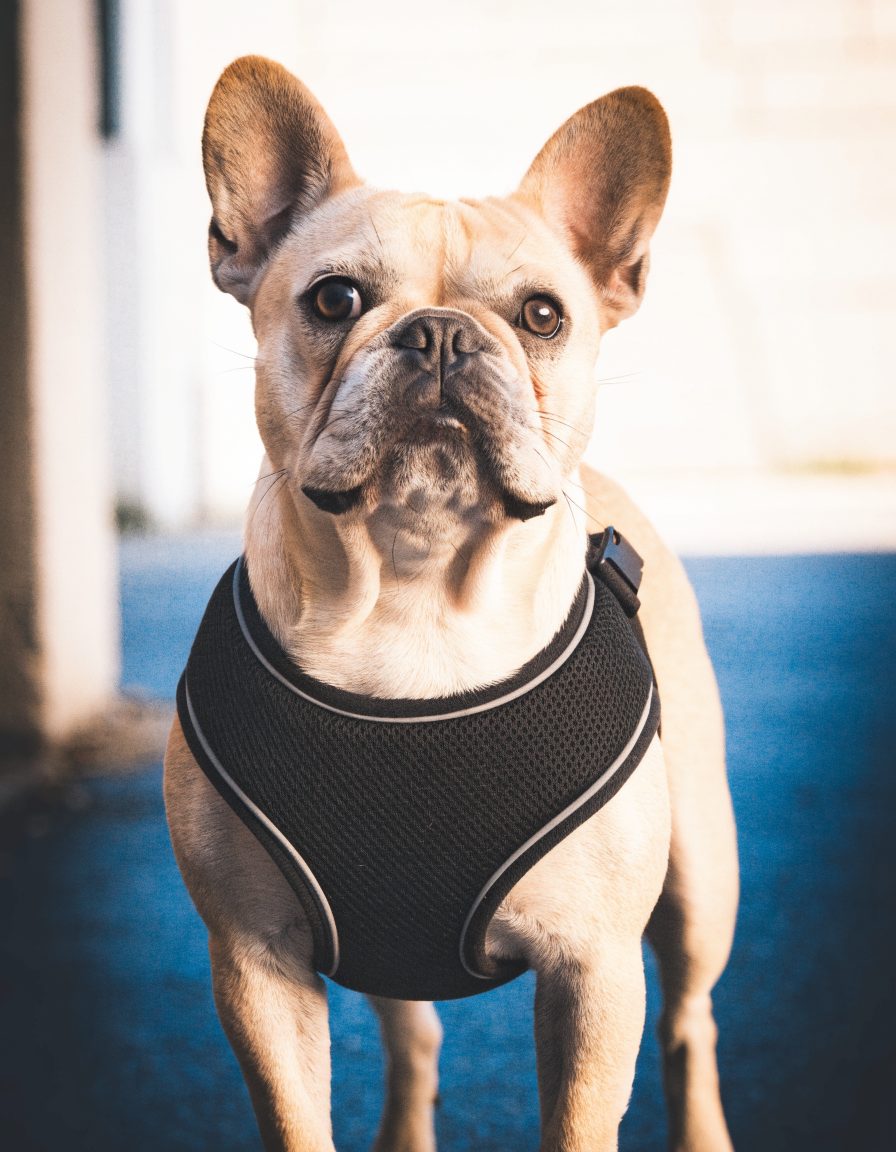
Most of the harness-versus-collar debate is opinion. A few researchers have actually measured it. Here is what they found, and what it means for a dog that weighs 4 to 30 pounds.
What the studies measured
A collar raises pressure in the eyes. A harness did not.
In 2006, a team of veterinary eye researchers measured eye pressure in 26 dogs (51 eyes) while the dogs pulled against a leash, once on a collar and once on a harness. Pulling on a collar raised eye pressure significantly over baseline. Pulling on a harness did not produce a significant rise. The authors advised that dogs with weak or thin corneas, glaucoma, or other conditions where higher eye pressure could do harm should wear a harness, especially during exercise.
The same paper is honest about harnesses too. The authors noted that many harnesses still press at the thoracic inlet, the base of the neck where it meets the chest, and that a harness lets a dog pull harder than a collar does. Where a harness sits matters.
Sensors under the throat pick up real force on an ordinary walk
A 2019 study in Veterinary and Animal Science placed a pressure sensor between the collar and the front of the dog's neck, the throat side, and walked dogs on three different collars, each fitted with the standard two-finger gap. The material of the collar changed how much pressure and peak force reached the neck. That is the force on a normal walk, not a lunge.
On a model neck, the numbers were large
A 2020 study by Carter and colleagues tested collar types on a simulated neck and reported pressures between 83 and 832 kPa. Collar type changed the contact area the force was spread over.
Why this matters more for a small dog
On a large dog, a collar sits on a thick, muscled neck. On a 4 lb Yorkie, it sits across most of the neck there is, right over the windpipe. Toy breeds are the dogs most often diagnosed with tracheal collapse, and VCA lists pressure on the windpipe, such as from a collar, among the triggers for coughing. Flat-faced breeds start with a narrow airway: VCA advises that dogs with brachycephalic airway syndrome wear a harness that does not tug at the neck, and Cornell's guidance is simply to use a harness instead of a neck collar.
Collar, over-the-head harness, step-in vest
| Flat collar | Over-the-head harness | Step-in vest | |
|---|---|---|---|
| Where the pull lands | Front of the neck | Neck loop and chest, depends on fit | Chest |
| Goes over the head | Yes | Yes | No, the dog steps in |
| Can ride up toward the throat | Sits on it | Often, if the neck loop is loose | Rarely, if fitted snug on the back |
| Good for | ID tags, calm dogs that do not pull | General walking for dogs without airway issues | Toy breeds, flat-faced breeds, dogs with a cough |
When a collar is still fine
A collar is a good way to keep an ID tag on a dog at all times. The issue is the leash, not the collar. Many owners of small dogs keep a light collar for tags and clip the leash only to a harness. If your dog has a diagnosed airway condition, ask your vet whether even a tag collar is a good idea, or hang the tag from the harness ring at the back.
How to choose
- Toy breed, flat-faced breed, cough, or eye problems: walk on a harness. Read what to look for in a harness before you buy.
- Healthy dog that pulls hard: a harness takes the force off the neck, and training reduces the pulling.
- Healthy dog that walks on a loose leash: either works.
Whatever you choose, do the pull test: clip the leash, pull gently forward, and watch where the straps go. If anything moves up toward the throat, the leash is still reaching the neck.